Tall Houseplants Safe for Cats: Beyond the Usual Palm List
Seven tall houseplants that are genuinely safe for cats per the ASPCA list, including several that are not palms, with honest notes on size and difficulty.
Most lists of tall houseplants safe for cats stop at palms. This roundup leads with the plants people have not heard of, every one of them confirmed non-toxic to cats on the ASPCA list and capable of reaching waist height or well beyond. They are ordered roughly easiest first, so the most forgiving, most widely available picks come at the top.
How these plants were chosen
Three things had to be true for a plant to make this list. It had to appear on the ASPCA list of non-toxic plants, so a curious cat that takes a bite is not poisoned. It had to reach genuine height indoors, at least waist high and in some cases the ceiling, because a tall plant is the whole point. And it had to be sold widely enough that you can actually buy one without hunting. Where a plant carries a real compromise, on light, humidity or eventual size, that is stated plainly rather than glossed over.
Tall houseplants safe for cats, from easiest to fussiest
Money tree
Pachira aquatica. The braided money tree is the easiest tall pick here: it is on the ASPCA non-toxic list, it climbs past shoulder height indoors, and it forgives the odd missed watering. Give it bright indirect light and water only when the top inch or two (3 to 5 cm) of soil have dried, since standing wet is what kills it. Its main quirk is a dislike of cold drafts and sudden moves, which show up as dropped leaflets. Full details are in our money tree care guide.
Ponytail palm
Beaucarnea recurvata. Despite the name, the ponytail palm is not a true palm at all: it is closer to an agave, with a swollen base that stores water like a succulent. It is on the ASPCA non-toxic list and, given years and bright light, it will reach the ceiling. Water it sparingly and let the soil dry right out, because that fat base means it hates sitting wet. The honest caveat is patience, as it grows slowly and a floor-height specimen takes a long time or a big budget. See the ponytail palm care guide for more.
Norfolk Island pine
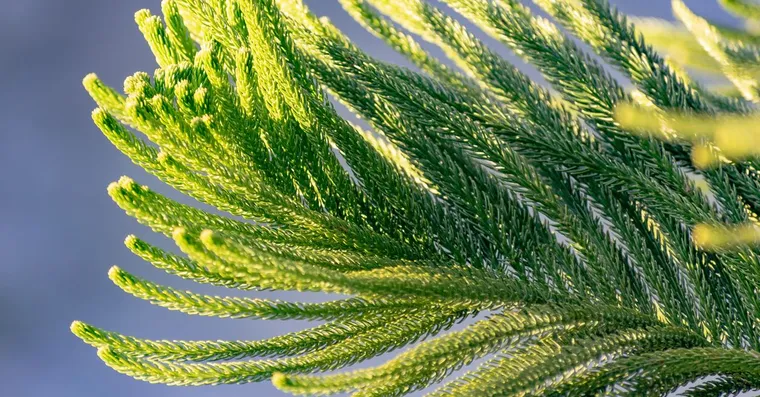
Araucaria heterophylla. Another honest misnomer: the Norfolk Island pine is not a pine, but a subtropical conifer relative often sold as a living Christmas tree. It is on the ASPCA non-toxic list and grows into a soft, tiered column that can touch the ceiling. The catch is that it sulks if allowed to dry out fully, shedding lower branches that never grow back, so keep the soil lightly moist and the air humid. Give it bright light and it rewards you; leave it dry in a dark corner and it thins out fast.
Banana plant
Musa species. If you want height fast and a real statement, an indoor banana throws up huge paddle-shaped leaves and can fill a corner in a single season. Bananas are on the ASPCA non-toxic list, so the dramatic foliage is safe around cats. Be honest with yourself first, though: they want serious light, high humidity and generous water and feeding, or the leaves brown and tear at the edges. This is the most demanding plant on the list and the wrong choice for a dim room.
Parlour palm
Chamaedorea elegans. The parlour palm earns its place because it is the rare tall plant that copes with lower light, which is where cat households often need one. It is a long-standing entry on the ASPCA non-toxic list and reaches head height over time, with fine, arching fronds. Keep the soil evenly moist but never soggy, and watch for spider mites, which move in when the air is dry. Our parlour palm care guide covers the detail.
Bamboo palm
Chamaedorea seifrizii. Think of the bamboo palm as the parlour palm’s taller, bushier cousin: it forms clumping canes that reach 6 feet (2 m) and screen off a corner. Like its relatives in the Chamaedorea genus, it is on the ASPCA non-toxic list, so it is safe to plant near a cat. Give it medium indirect light, keep the soil lightly moist and raise the humidity if you can, since dry air invites spider mites here too. It is more forgiving of shade than a banana but still wants better light than a true low-light plant.
Cast iron plant
Aspidistra elatior. The cast iron plant is the toughest name on this list, shrugging off deep shade, dry spells and cold rooms that would finish other plants. It is on the ASPCA non-toxic list and is about as close to unkillable as houseplants get. The honest compromise is height: it tops out around knee to hip level, so it fills a low corner rather than reaching the ceiling. Water it when the top of the soil dries, keep it out of direct sun, and read the cast iron plant care guide if you want a plant you can genuinely forget about.
Safe does not mean chew-proof
Non-toxic is not the same as chew-proof. Every plant here is safe if your cat takes a bite, but a bored cat can still shred foliage, knock over a pot, or turn a young banana leaf into a toy. The simplest defense is to give the cat a legal target.
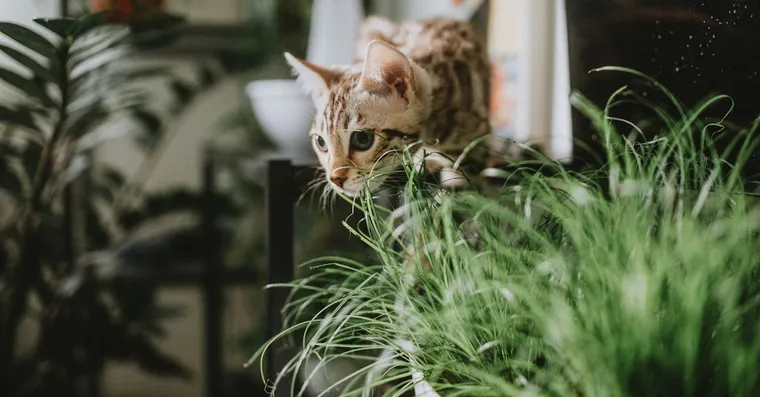
A cat that has its own patch of grass to chew is far less interested in yours.
Keep a pot of cat grass nearby as a decoy, raise fragile plants off the floor while they establish, and check the ASPCA non-toxic list yourself before adding anything new, since common names are slippery and one “palm” or “pine” is not always another. For the wider picture, our guide to pet-safe houseplants covers trailing and tabletop options too.
Where to start if you only buy one
If you want height with the least fuss, start with the money tree: it is genuinely tall, widely sold and hard to kill. For a plant that will eventually reach the ceiling, the ponytail palm and Norfolk Island pine are the standout non-palms, as long as you can meet the pine’s need for steady moisture. Whichever you choose, remember that safe means non-toxic rather than chew-proof, so a pot of cat grass alongside it is the cheapest insurance you will buy.
Where to go next
Pet-Safe Houseplants: A Guide for Cat and Dog Owners
Many popular houseplants are toxic to cats and dogs. Here are genuinely pet-safe options, and the common plants to avoid.
Majesty Palm Care: Light, Water, and Why It Browns
Majesty palms are sold as easy indoor palms and are not. They want more light, more water, and more humidity than a living room usually offers.
Norfolk Island Pine Care: Keeping It Alive After Christmas
A Norfolk Island pine is a tropical tree, not a conifer, and it will not survive outdoors in a cold winter. Here is what it actually needs indoors.
Not sure what plant you have? Identify it from a photo and we will point you at its care guide.
Sources
- ASPCA Animal Poison Control lists Money Tree (Pachira aquatica) as Non-Toxic to Dogs, Non-Toxic to Cats, Non-Toxic to Horses.
- ASPCA Animal Poison Control lists Pony Tail (Beaucarnea recurvata) as Non-Toxic to Dogs, Non-Toxic to Cats, Non-Toxic to Horses.
- ASPCA Animal Poison Control lists Australian Pine (Araucaria heterophylla, also called Norfolk Island Pine) as Non-Toxic to Dogs, Non-Toxic to Cats, Non-Toxic to Horses.
- ASPCA Animal Poison Control lists Banana (Musa acuminata) as Non-Toxic to Dogs, Non-Toxic to Cats, Non-Toxic to Horses.
- ASPCA Animal Poison Control lists Parlor Palm (Chamaedorea elegans) as Non-Toxic to Dogs, Non-Toxic to Cats.
- ASPCA Animal Poison Control lists Bamboo Palm (Chamaedorea elegans) as Non-Toxic to Dogs, Non-Toxic to Cats, Non-Toxic to Horses.
- ASPCA Animal Poison Control lists Cast Iron Plant (Aspidistra elatior) as Non-Toxic to Dogs, Non-Toxic to Cats, Non-Toxic to Horses.